Fluorotelomers Market Size by Product, Application and Region - Segment-Level Market Assessment, Growth Opportunity Analysis, Competitive Mapping & Forecast to 2034

12.4%
CAGR (2026-2034)
967.51 USD Mn.
Forecast Market Size
322
Report Pages
164
Market Tables

Overview

fluorotelomers market was valued at USD 967.51 Mn. in 2025 and is expected to reach USD 2750 Mn. by 2034 at a CAGR of 12.4% during the forecast period.

Fluorotelomers Market Overview:

The global Fluorotelomers Market is expected to grow at a steady CAGR during the forecast period, driven by the increasing demand for high-performance fluorochemical materials across textiles, firefighting foams, food packaging, electronics, and specialty industrial applications. Fluorotelomers are fluorinated compounds widely used to impart water repellency, oil resistance, stain protection, and chemical durability to a variety of products. Their superior performance characteristics make them essential in manufacturing protective coatings, surfactants, and specialty polymers for industrial and consumer applications.

The market is witnessing continuous innovation as manufacturers focus on developing short-chain fluorotelomer chemistries and environmentally compliant products in response to evolving PFAS regulations. Increasing investments in semiconductor manufacturing, advanced electronics, and high-performance coatings are creating new growth opportunities for fluorotelomer manufacturers. At the same time, advancements in sustainable production technologies, regulatory compliance initiatives, and the development of fluorine-efficient formulations are reshaping the competitive landscape. Growing demand from emerging industrial applications, coupled with expanding research and development activities aimed at improving product performance and reducing environmental impact, is expected to support the long-term growth of the global Fluorotelomers Market.
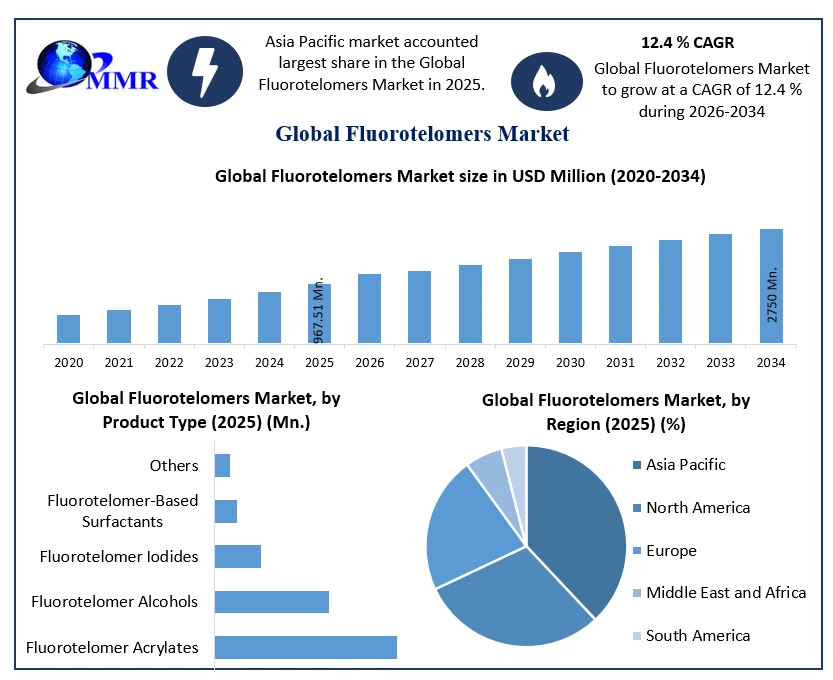
 

Fluorotelomers Market Growth Outlook

To Know About The Research Methodology :-  Request Free Sample Report

Global Fluorotelomers Market Dynamics:

Growing demand for high-performance water- and oil-repellent materials is driving the market

The increasing demand for high-performance surface treatment chemicals across the textile, paper, packaging, construction, and industrial sectors is a major factor driving the global fluorotelomers market. Fluorotelomers offer excellent water, oil, stain, and chemical resistance, making them essential ingredients in durable water-repellent (DWR) coatings, firefighting foams, specialty surfactants, and performance coatings. The growing use of protective clothing, industrial textiles, food packaging materials, and specialty coatings, coupled with expanding applications in electronics and semiconductor manufacturing, continues to support market growth. Additionally, the transition from long-chain fluorochemicals to short-chain fluorotelomer-based products has sustained demand in several industrial applications due to their comparatively improved environmental profile.

Increasing adoption of short-chain fluorotelomer chemistry and advanced industrial applications is creating market opportunities

Growing regulatory compliance requirements are encouraging manufacturers to develop next-generation short-chain (C6) fluorotelomer technologies with improved environmental performance while maintaining high product functionality. At the same time, rising demand from semiconductor manufacturing, advanced electronics, aerospace, electric vehicles, and specialty coatings is creating new opportunities for fluorotelomer producers. Manufacturers are also investing in fluorine-efficient production processes, emission control technologies, and innovative fluoropolymer intermediates to strengthen their product portfolios and meet evolving industry requirements. These developments are expected to create significant opportunities for companies operating in high-value industrial applications.

Stringent PFAS regulations and environmental concerns are restraining market growth

Increasing global regulatory scrutiny surrounding per- and polyfluoroalkyl substances (PFAS) remains one of the most significant restraints for the fluorotelomers market. Regulatory agencies across North America and Europe are implementing stricter restrictions on the production, use, and disposal of PFAS-related chemicals due to concerns over environmental persistence and potential health impacts. Compliance with evolving regulations requires substantial investments in product reformulation, environmental monitoring, and manufacturing upgrades, increasing operational costs for manufacturers. In addition, growing consumer preference for fluorine-free alternatives is limiting demand in certain consumer-facing applications such as textiles and food packaging.

Growing substitution by fluorine-free alternatives and rising compliance costs remain key market challenges

The increasing development of fluorine-free coatings, silicone-based repellents, and hydrocarbon-based surface treatment technologies presents a significant challenge for the fluorotelomers market. Many end-use industries are actively evaluating alternative chemistries to reduce regulatory risks and improve sustainability. Additionally, manufacturers face rising compliance costs associated with environmental reporting, PFAS monitoring, waste management, and product certification. Maintaining product performance while meeting increasingly stringent environmental standards and managing complex global regulatory frameworks continues to be a major challenge for fluorotelomer producers.

Key Trends in the Global Fluorotelomers Market

  • Growing transition toward short-chain fluorotelomer chemistry: Manufacturers are increasingly shifting from long-chain fluorochemicals to short-chain (C6) fluorotelomer-based products to comply with evolving environmental regulations while maintaining high levels of water, oil, and stain repellency. This transition is driving innovation across textile, packaging, and industrial coating applications.
  • Rising demand for high-performance specialty coatings and surface treatments: The increasing use of fluorotelomers in textiles, construction materials, automotive components, electronics, and industrial coatings is driving market growth. Their superior resistance to water, oil, chemicals, and harsh environmental conditions makes them essential for high-performance applications.
  • Increasing investments in PFAS-compliant and sustainable fluorochemical technologies: Companies are investing in advanced manufacturing processes, emission reduction technologies, and next-generation fluorotelomer formulations to address tightening global PFAS regulations. The focus on improving environmental performance while maintaining product functionality is becoming a key industry trend.
  • Expansion of fluorotelomer applications in electronics and semiconductor manufacturing: Growing demand for advanced electronic devices, semiconductors, and precision industrial components is increasing the adoption of fluorotelomer-based specialty chemicals. Their excellent chemical resistance and surface performance make them suitable for high-purity manufacturing environments.
  • Growing research into fluorine-efficient and alternative performance materials: Manufacturers are increasing R&D investments to develop fluorine-efficient products, recyclable fluorochemical solutions, and next-generation surface treatment technologies. At the same time, companies are exploring innovative formulations that balance regulatory compliance, sustainability, and high-performance requirements, ensuring long-term competitiveness in the global fluorotelomers market.

Fluorotelomers Market Segment Analysis:
By Product Type,

Fluorotelomer alcohols serve as important chemical intermediates in the production of fluorinated surfactants, polymers, and surface-treatment agents. Fluorotelomer acrylates are widely used in specialty coatings and textile treatments, while Fluorotelomer iodides serve as key intermediates in the synthesis of various fluorinated chemicals and specialty compounds, supporting downstream chemical manufacturing. Fluorotelomer-based surfactants contribute to surface modification by influencing surface tension, wetting, and spreading characteristics in selected industrial formulations. Other product categories include specialized fluorotelomer derivatives designed for niche applications in chemical processing, protective coatings, and advanced material development.

By Application, 

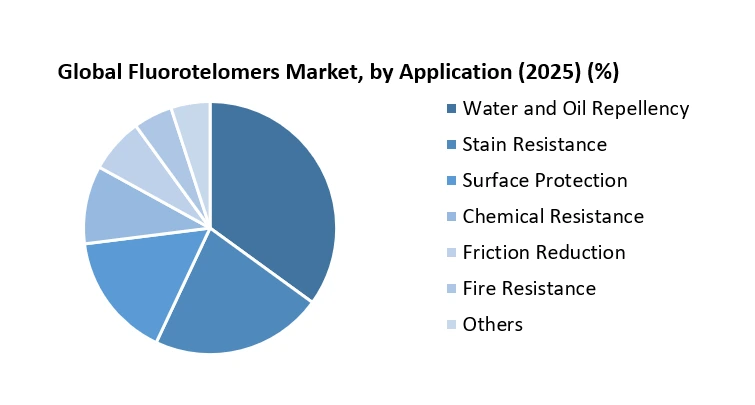
The Global Fluorotelomers Market is segmented by application into water and oil repellency, stain resistance, surface protection, friction reduction, chemical resistance, fire resistance, and others. Water and oil repellency represents a major application area due to the use of fluorotelomer-based chemicals in textiles, carpets, upholstery, paper packaging, and protective coatings. Stain resistance supports demand in apparel, furniture, and industrial fabrics. Surface protection and chemical resistance applications benefit from the ability of fluorinated materials to provide protective surface properties. Friction reduction and fire resistance serve specialized industrial applications, while other uses include niche surface-treatment and specialty chemical formulations.

Fluorotelomers Market by Application

Global Fluorotelomers Market Regional Insights:

North America

North America held a significant share of the global fluorotelomers market in 2025, driven by the presence of a well-established specialty chemicals industry, strong demand from aerospace, defense, electronics, and industrial manufacturing sectors, and continuous investments in high-performance materials. The United States remains the largest market in the region, supported by demand for fluorotelomer-based coatings, surfactants, and specialty polymers. However, stringent PFAS regulations are encouraging manufacturers to develop short-chain fluorotelomer products and invest in environmentally compliant technologies.

Asia-Pacific

Asia-Pacific dominated the global fluorotelomers market in 2025 and is expected to register the fastest growth during the forecast period. Rapid industrialization, expanding textile manufacturing, increasing electronics production, and strong growth in packaging and construction industries are driving market demand. China, Japan, South Korea, and India are major producers and consumers of fluorotelomers due to their extensive chemical manufacturing capabilities and growing demand for high-performance coatings, specialty chemicals, and water- and oil-repellent materials. Rising investments in semiconductor manufacturing and industrial infrastructure further support regional market expansion.

Europe

Europe represents a mature market, supported by advanced chemical manufacturing, growing adoption of sustainable specialty chemicals, and increasing demand from automotive, textile, and industrial applications. Countries such as Germany, France, Italy, and the United Kingdom are investing in next-generation fluorochemical technologies while complying with stringent environmental and PFAS-related regulations. Manufacturers are increasingly focusing on developing short-chain fluorotelomer products and environmentally responsible production processes to meet evolving regulatory standards and customer requirements.

Middle East & Africa and South America

The Middle East & Africa and South America are expected to witness steady growth, driven by increasing industrialization, infrastructure development, and expanding applications in textiles, construction, oil & gas, and food packaging. Countries such as Brazil, Saudi Arabia, the UAE, and South Africa are experiencing growing demand for specialty coatings, industrial chemicals, and performance materials. Although these regions currently account for a smaller share of the global market, rising investments in manufacturing and industrial diversification are expected to create new growth opportunities for fluorotelomer manufacturers over the forecast period.

Competitive Landscape – Global Fluorotelomers Market

The global fluorotelomers market is moderately consolidated, with leading fluorochemical manufacturers competing through product innovation, regulatory compliance, capacity expansion, and the development of next-generation fluorinated materials. As environmental regulations surrounding per- and polyfluoroalkyl substances (PFAS) become increasingly stringent, companies are investing heavily in short-chain fluorotelomer technologies, sustainable manufacturing processes, and advanced fluorochemical formulations that deliver high performance while reducing environmental impact. Market participants are also strengthening their presence through strategic collaborations, research and development initiatives, and expansion into high-growth industries such as textiles, food packaging, specialty coatings, semiconductors, and industrial surface treatment solutions.

Leading companies including The Chemours Company, AGC Inc., Daikin Industries Ltd., Archroma Management LLC, Clariant AG, Gujarat Fluorochemicals Limited (GFL), Merck KGaA (Sigma-Aldrich), DYNAX Corporation, SRF Limited, and Arkema S.A. are focusing on expanding specialty fluorochemical portfolios, improving manufacturing efficiency, and developing PFAS-compliant fluorotelomer products. Their key strategies include investments in advanced fluoropolymer technologies, environmentally responsible production processes, expansion of global distribution networks, and partnerships with textile, electronics, and specialty chemical manufacturers. In addition, companies are increasing R&D investments to develop high-performance water-, oil-, and stain-resistant materials while addressing evolving regulatory requirements and growing customer demand for sustainable fluorochemical solutions.

Recent Developments – Global Fluorotelomers Market

  • June 2025: The Chemours Company continued expanding its portfolio of next-generation fluorochemical technologies, focusing on PFAS-compliant and high-performance fluorotelomer solutions for industrial and specialty applications.
  • May 2025: AGC Inc. increased investments in advanced fluorochemical manufacturing and specialty fluorinated materials to strengthen its position in electronics, semiconductor, and industrial applications.
  • April 2025: Daikin Industries Ltd. expanded R&D activities focused on environmentally responsible fluorochemical technologies and next-generation fluorotelomer products to meet evolving global regulatory standards.
  • March 2025: Archroma Management LLC strengthened its sustainable textile chemicals portfolio by expanding fluorotelomer-based durable water-repellent (DWR) technologies for performance apparel and technical textiles.
  • January 2025: Leading fluorochemical manufacturers accelerated investments in short-chain (C6) fluorotelomer technologies, advanced production processes, and sustainable specialty chemicals to address increasing global demand while complying with stricter PFAS regulations.

Fluorotelomers Market Scope: Inquire before buying

Fluorotelomers Market
Report Coverage Details
Base Year: 2025 Forecast Period: 2026-2034
Historical Data: 2020 to 2025 Market Size in 2025: USD 967.51 Mn.
Forecast Period 2026 to 2034 CAGR: 12.4% Market Size in 2034: USD 2750 Mn.
Segments Covered: by Product Type Fluorotelomer Alcohols
Fluorotelomer Iodides
Fluorotelomer Acrylates
Fluorotelomer-Based Surfactants
Others
by Form Liquid
Solid
Powder
Others
by Application Water and Oil Repellency
Stain Resistance
Surface Protection
Friction Reduction
Chemical Resistance
Fire Resistance
Others
by End-Use Industry Textile and Apparel
Paper and Packaging
Firefighting and Fire Safety
Coatings and Surface Treatment
Personal Care and Cosmetics
Industrial and Specialty Chemicals
Consumer Products
Others

Fluorotelomers Market, by Region

North America (United States, Canada and Mexico)
Europe (UK, France, Germany, Italy, Spain, Sweden, Austria and Rest of Europe)
Asia Pacific (China, South Korea, Japan, India, Australia, Indonesia, Malaysia, Vietnam, Taiwan, Bangladesh, Pakistan and Rest of APAC)
Middle East and Africa (South Africa, GCC, Egypt, Nigeria and Rest of ME&A)
South America (Brazil, Argentina Rest of South America)

The report helps in understanding fluorotelomers market dynamics, structure, by analyzing the market segments and projects the flurotelomers market size. The clear representation of competitive analysis of key players by product, price, financial position, product portfolio, growth strategies, and regional presence in the global flurotelomers market make the report investor’s guide.

The report provides detail study of the key players of the global flurotelomers market with their growth by conserving past data. In addition to that, report helps reader with the company profile, Company Overview, Financial Overview, Product Portfolio, Business Strategy, Recent Developments and Development Footprint analysis and growth strategies for each.

Fluorotelomers Market Key Players

North America 
1. The Chemours Company
2. DuPont de Nemours, Inc.
3. 3M Company
4. Daikin America, Inc.
5. AGC Chemicals Americas, Inc.
6. Honeywell International Inc.
7. Sigma-Aldrich Corporation
8. Halocarbon Products Corporation
9. Dynax Corporation
10. Wilshire Technologies, Inc.
11. Fluorous Technologies, Inc.
12. Fluoryx Inc.
13. SynQuest Laboratories, Inc.
14. Oakwood Products, Inc.
15. Santa Cruz Biotechnology, Inc.
16. Others

Europe
16. Solvay S.A.
17. Arkema S.A.
18. Saint-Gobain S.A.
19. BASF SE
20. Bayer AG
21. Merck KGaA
22. AGC Chemicals Europe, Ltd.
23. Archroma Management LLC
24. Fluorochem Ltd
25. Apollo Scientific Ltd
Others

Asia Pacific
26. Daikin Industries, Ltd.
27. AGC Inc.
28. Central Glass Co., Ltd.
29. DIC Corporation
30. TCI Chemicals
31. Gujarat Fluorochemicals Limited
32. SRF Limited
33. Dongyue Group Limited
34. Zhejiang Juhua Co., Ltd.
35. Shanghai 3F New Materials Co., Ltd.
36. Changshu 3F Zhonghao New Chemical Materials Co., Ltd.
37. Zhonghao Chenguang Research Institute of Chemical Industry
38. Jiangsu Meilan Chemical Co., Ltd.
39. Shandong Huafluor Chemical Co., Ltd.
40. Inner Mongolia Xinghe Fluorine Chemical Co., Ltd.
41. Fujian Shaowu Yongfei Chemical Co., Ltd.
42. Guangdong Juhua Technology Co., Ltd.
43. Hangzhou Leap Chem Co., Ltd.
Others

South America
44. Orbia Advance Corporation, S.A.B. de C.V.
Others

Frequently Asked Questions:

1. Which region has the largest share in Global Fluorotelomers Market?
Ans: Asia Pacific region held the highest share in 2025.

2. What is the growth rate of Global Fluorotelomers Market?
Ans: The Global Fluorotelomers Market is growing at a CAGR of 12.4% during forecasting period 2026-2032.

3. What is scope of the Global Fluorotelomers Market report?
Ans: Global Fluorotelomers Market report helps with the PESTEL, PORTER, COVID-19 Impact analysis, Recommendations for Investors & Leaders, and market estimation of the forecast period.

4. Who are the key players in Global Fluorotelomers Market?
Ans: The important key players in the Global Fluorotelomers Market are – DuPont, Fluoryx Inc, Wilshire Technologies, Fluorous Technologies Inc, TCI Chemicals, Sigma-Aldrich Corporation, Asahi Glass Co. Inc., Chemours Company, Indofine Chemical Co. Inc., AGC Chemicals Americas, Archroma, Dynax Fluorochemicals, Daikin America, Clariant, 3M Company, Santa Cruz Biotechnology, Inc.

5. What is the study period of this Market?
Ans: The Global Fluorotelomers Market is studied from 2020 to 2034.

Table of Contents

1. GLOBAL FLUOROTELOMERS MARKET INTRODUCTION 1.1. Executive Market Landscape and Industry Overview 1.1.1 Global Fluorotelomers Market Size (Value USD Million & Volume in Metric Tons), 2025–2034 1.1.2 Historical Market Size Trends and Growth Momentum Analysis Across Fluorotelomer Industry 1.1.3 Forecast Revenue Projections with Underlying Market Growth Driving Factors 1.1.4 Demand-Supply Balance and Its Influence on Market Expansion Potential 1.1.5 Impact of Macroeconomic Indicators on Fluorotelomers Market Growth Trajectory 1.1.6 Global Production and Consumption Trends Across Major Fluorotelomer Applications 1.1.7 Long-Term Market Outlook Highlighting Structural Growth Opportunities Through 2034 1.1.8 CAGR Analysis of Global Fluorotelomers Market (2025–2034) 1.2. Fluorotelomers Market Dynamics 1.2.1 Fluorotelomers Market Trends 1.2.2 Fluorotelomers Market Dynamics 1.2.3 Drivers 1.2.4 Restraints 1.2.5 Opportunities 1.2.6 Challenges 1.2.7 PORTER’s Five Forces Analysis 1.2.8 PESTLE Analysis 1.3. Pricing Structure and Value Chain Profitability Assessment 1.3.1 Comprehensive Breakdown of Fluorotelomer Cost Structure Across Value Chain 1.3.2 Margin Distribution Analysis Among Fluorotelomer Manufacturers, Distributors, and End-Use Industries 1.3.3 Impact of Fluorine-Based Raw Material Price Fluctuations on Fluorotelomer Pricing Strategies 1.3.4 Impact of Production Scale and Process Efficiency on Fluorotelomer Pricing 1.3.5 Pricing Comparison Across Different Fluorotelomer Product Types and Grades 1.3.6 Role of Product Purity, Performance Characteristics, and Certification in Influencing Final Pricing 1.3.7 Profitability Trends and Revenue Optimization Strategies Across Industry Participants 1.4. Fluorotelomer Feedstock Procurement and Raw Material Supply Dynamics 1.4.1 Fluorinated Raw Material Sourcing Models and Supplier Dependency Risk Assessment 1.4.2 Perfluoroalkyl and Fluoroalkyl Feedstock Availability Across Major Producing Regions 1.4.3 Fluorine Chemistry Feedstock Price Volatility and Impact on Production Cost Structures 1.4.4 Supply Availability of Key Chemical Intermediates Used in Fluorotelomer Manufacturing 1.4.5 Supplier Concentration and Raw Material Procurement Risk Analysis 1.4.6 Direct Sourcing Models Enhancing Supply Security and Cost Optimization 1.4.7 Raw Material Quality Influence on Fluorotelomer Product Performance and Application Suitability 1.5. End-Use Industry Evolution and Fluorotelomer Consumption Trends 1.5.1 Rising Demand for Fluorotelomers Across High-Performance Industrial Applications 1.5.2 Influence of Industrial and Consumer Product Manufacturing Trends on Fluorotelomer Consumption 1.5.3 Industry-Specific Factors Influencing Fluorotelomer Adoption 1.5.4 Growing Demand for Fluorotelomer-Based Performance Chemicals 1.5.5 Application-Specific Product Requirements Driving Fluorotelomer Demand 1.5.6 Increasing Preference for High-Performance Fluorinated Materials Across End-Use Industries 1.6. Product Innovation and Application Development Trends 1.6.1 Emergence of Advanced Fluorotelomer Chemistry for High-Performance Applications 1.6.2 Development of Low-Impact and Next-Generation Fluorotelomer Products 1.6.3 Innovation in Fluorotelomer-Based Surface Treatment and Performance Applications 1.6.4 Product Formulation Innovations Driving Application-Specific Differentiation 1.6.5 Influence of Global Chemical Industry Trends on Fluorotelomer Product Innovation 1.6.6 Growth of Alternative Fluorotelomer Chemistries Supporting Regulatory and Sustainability Requirements 1.7. Manufacturing Technology and Process Innovation Development 1.7.1 Advanced Fluorotelomer Manufacturing Technologies Supporting Production Efficiency 1.7.2 Process Optimization Strategies Enhancing Product Yield and Quality Consistency 1.7.3 Adoption of Automation in Fluorotelomer Production Processes 1.7.4 Integration of Digital Monitoring Systems for Manufacturing Quality Control 1.7.5 Energy-Efficient Technologies Reducing Operational Production Costs 1.7.6 Industry 4.0 Implementation in Modern Fluorotelomer Manufacturing Facilities 1.8. Distribution Evolution and Supply Chain Channel Dynamics 1.8.1 Evolution of Direct-to-Industrial Customer Sales Models in Fluorotelomer Industry 1.8.2 Role of Chemical Distributors in Expanding Market Accessibility 1.8.3 Growth of Specialty Chemical Distribution Networks Across Global Markets 1.8.4 Impact of Regional Distribution Hubs on Product Availability 1.8.5 Digitalization of Industrial Chemical Procurement and B2B Sales Channels 1.8.6 Omnichannel Distribution Strategies Enhancing Customer Reach and Supply Chain Efficiency 1.9. Digital Transformation and Industrial Marketing Strategies 1.9.1 Digital Platforms Driving Fluorotelomer Product Awareness Among Industrial Buyers 1.9.2 Technical Content Marketing Strategies Supporting Customer Education 1.9.3 Data-Driven Customer Targeting Across Fluorotelomer End-Use Industries 1.9.4 Digital Customer Engagement Strategies Supporting B2B Relationship Development 1.9.5 Impact of Online Technical Resources on Industrial Product Selection Processes 1.9.6 Digital Sales and Marketing Strategies Supporting Global Market Expansion 1.10. Sustainability Trends and Environmental Management Dynamics 1.10.1 Rising Industry Focus on Sustainable Fluorochemical Manufacturing 1.10.2 Environmental Impact of Fluorotelomer Production and Mitigation Strategies 1.10.3 Corporate Sustainability Initiatives Influencing Fluorotelomer Industry Positioning 1.10.4 Carbon Reduction Efforts Across Fluorotelomer Production and Supply Chains 1.10.5 Chemical Lifecycle Management and Environmental Risk Reduction Strategies 1.10.6 Circular Economy and Waste Management Practices in Fluorochemical Manufacturing 1.11. Regulatory, Environmental, and Chemical Safety Trends 1.11.1 Increasing Regulatory Scrutiny of Fluorinated Chemicals and Fluorotelomer-Based Products 1.11.2 PFAS-Related Regulatory Developments and Their Impact on Fluorotelomer Applications 1.11.3 Environmental and Human Health Considerations Influencing Product Development 1.11.4 Chemical Registration and Compliance Requirements Across Major Markets 1.11.5 Restrictions on Specific Fluorotelomer Applications and Their Market Impact 1.11.6 Development of Safer and Lower-Impact Alternatives to Traditional Fluorotelomer Products 1.12. Import-Export Trade Analysis (2025) 1.12.1 Global Trade Flow Trends Impacting Fluorotelomers Market Development 1.12.2 Import-Export Patterns Influencing Product Pricing and Availability 1.12.3 Supply Chain Disruptions Affecting Fluorotelomer Production and Distribution Efficiency 1.12.4 Geopolitical Factors Impacting Fluorochemical Trade Routes 1.12.5 Tariff and Regulatory Barriers Affecting Cross-Border Fluorotelomer Trade 1.12.6 Post-Pandemic Supply Chain Resilience and Adaptation Strategies 1.13. Strategic Risk Assessment 1.13.1 Regulatory Restrictions Impacting Fluorotelomer Industry Growth and Profitability 1.13.2 Raw Material Price Volatility Affecting Industry Profitability and Stability 1.13.3 Supply Chain Disruptions Affecting Product Availability and Distribution 1.13.4 Environmental Concerns Influencing Customer Adoption and Product Positioning 1.13.5 High Compliance Costs Limiting Market Expansion Opportunities 1.13.6 Competitive Pressure from Alternative Fluorinated and Non-Fluorinated Technologies 1.14. Application-Specific Demand and Industry Consumption Analysis 1.14.1 Fluorotelomer Demand Across Textile and Surface Treatment Applications 1.14.2 Demand Trends Across Firefighting Foam and Fire-Resistant Applications 1.14.3 Fluorotelomer Consumption in Paper and Packaging Applications 1.14.4 Fluorotelomer Use Across Coatings, Polishes, and Industrial Treatments 1.14.5 Demand Across Personal Care and Consumer Product Applications 1.14.6 Emerging Applications Creating New Fluorotelomer Market Opportunities 1.15. Regional Production and Consumption Dynamics 1.15.1 Regional Fluorotelomer Production Capacity and Utilization Trends 1.15.2 Regional Consumption Patterns Across Major End-Use Industries 1.15.3 Impact of Local Manufacturing Infrastructure on Market Development 1.15.4 Regional Supply-Demand Gaps and Import Dependency Analysis 1.15.5 Emerging Production Hubs and Investment Trends 1.15.6 Regional Competitive Advantages in Fluorotelomer Manufacturing 1.16. Manufacturing Capacity and Capacity Utilization Analysis 1.16.1 Global Fluorotelomer Manufacturing Capacity Trends 1.16.2 Capacity Expansion Strategies Across Major Producers 1.16.3 Production Capacity Utilization Rates Across Leading Manufacturing Regions 1.16.4 New Manufacturing Facility Investments and Expansion Projects 1.16.5 Impact of Capacity Utilization on Product Pricing and Profitability 1.16.6 Capacity-Demand Gap Analysis Across Major Markets 1.17. Regulatory Framework and Compliance Analysis 1.17.1 Global Chemical Safety Regulations Governing Fluorotelomer Manufacturing 1.17.2 PFAS-Related Regulations and Restrictions Across Major Markets 1.17.3 Chemical Registration and Environmental Compliance Requirements 1.17.4 Product Safety, Labeling, and Disclosure Requirements 1.17.5 Import-Export Compliance Requirements in International Fluorochemical Trade 1.17.6 Environmental Regulations Influencing Product Development and Manufacturing 1.17.7 Regional Regulatory Comparison Across North America, Europe, Asia Pacific, and MEA 1.18. Industrial Customer Adoption and Procurement Strategy Analysis 1.18.1 Industrial Customer Procurement Criteria Influencing Fluorotelomer Product Selection 1.18.2 Technical Performance Requirements Across Major End-Use Industries 1.18.3 Supplier Qualification and Vendor Approval Processes 1.18.4 Long-Term Contracting and Strategic Procurement Trends 1.18.5 Role of Technical Support and Application Expertise in Supplier Selection 1.18.6 Total Cost of Ownership Analysis Influencing Industrial Purchasing Decisions 1.19. Emerging Industrial Applications and Demand Patterns 1.19.1 Emerging Applications Driving Future Fluorotelomer Demand 1.19.2 Increasing Adoption Across High-Performance Specialty Chemical Applications 1.19.3 Demand Growth Across Developed and Emerging Industrial Markets 1.19.4 Influence of Technological Innovation on New Application Development 1.19.5 Application Substitution Trends Affecting Fluorotelomer Consumption 1.19.6 Industry Spending Analysis Across Key End-Use Segments 1.20. Alternative Technology and Substitution Analysis 1.20.1 Competitive Threat from Fluorine-Free Alternative Technologies 1.20.2 Substitution Trends Across Major Fluorotelomer Applications 1.20.3 Performance Comparison Between Fluorotelomer and Alternative Chemical Technologies 1.20.4 Cost Comparison of Fluorotelomer and Substitute Products 1.20.5 Regulatory Impact on Technology Substitution Decisions 1.20.6 Adoption Trends Toward Lower-Impact and Sustainable Alternatives 1.21. Fluorotelomers Market: Market size and Forecast by Segmentation (by Value USD Million and Volume in Metric Tons) (2025-2034) 1.21.1 Fluorotelomers Market Size and Forecast, By Product Type 1.21.2 Fluorotelomer Alcohols 1.21.3 Fluorotelomer Iodides 1.21.4 Fluorotelomer Acrylates 1.21.5 Fluorotelomer-Based Surfactants 1.21.6 Others 1.21.7 Fluorotelomers Market Size and Forecast, By Form 1.21.8 Liquid 1.21.9 Solid 1.21.10 Powder 1.21.11 Others 1.21.12 Fluorotelomers Market Size and Forecast, By Application 1.21.13 Water and Oil Repellency 1.21.14 Stain Resistance 1.21.15 Surface Protection 1.21.16 Friction Reduction 1.21.17 Chemical Resistance 1.21.18 Fire Resistance 1.21.19 Others 1.21.20 Fluorotelomers Market Size and Forecast, By End-Use Industry 1.21.21 Textile and Apparel 1.21.22 Paper and Packaging 1.21.23 Firefighting and Fire Safety 1.21.24 Coatings and Surface Treatment 1.21.25 Personal Care and Cosmetics 1.21.26 Industrial and Specialty Chemicals 1.21.27 Consumer Products 1.21.28 Others 1.21.29 Fluorotelomers Market Size and Forecast, By Region 1.21.30 North America 1.21.31 United States 1.21.32 Canada 1.21.33 Mexico 1.21.34 Europe 1.21.35 United Kingdom 1.21.36 France 1.21.37 Germany 1.21.38 Italy 1.21.39 Switzerland 1.21.40 Spain 1.21.41 Sweden 1.21.42 Russia 1.21.43 Rest of Europe 1.21.44 Asia Pacific 1.21.45 China 1.21.46 South Korea 1.21.47 Japan 1.21.48 India 1.21.49 Australia 1.21.50 Indonesia 1.21.51 Philippines 1.21.52 Malaysia 1.21.53 Vietnam 1.21.54 Thailand 1.21.55 Rest of Asia Pacific 1.21.56 Middle East And Africa 1.21.57 South Africa 1.21.58 Turkey 1.21.59 Saudi Arabia 1.21.60 UAE 1.21.61 Qatar 1.21.62 Egypt 1.21.63 Nigeria 1.21.64 Rest of ME&A 1.21.65 South America 1.21.66 Brazil 1.21.67 Argentina 1.21.68 Chile 1.21.69 Colombia 1.21.70 Rest Of South America 1.21.71 (Note: Segment-wise market size estimates for all regions and countries will follow the same structure throughout the final report.) 2. COMPETITIVE INTELLIGENCE & INDUSTRIAL ECOSYSTEM 2.1. Competitive Landscape 2.1.1 MMR Competition Matrix 2.1.2 Competitive Positioning of Leading Key Players [Revenue and Market Share(%)] 2.1.3 Key Players Benchmarking 2.1.4 Company Name 2.1.5 Headquarter 2.1.6 Fluorotelomer Product Portfolio 2.1.7 Fluorochemical Product Portfolio 2.1.8 Specialty Chemical Product Portfolio 2.1.9 Product Quality 2.1.10 Product Customization Capability 2.1.11 Manufacturing Capacity 2.1.12 Production Footprint 2.1.13 Supply Chain Strength 2.1.14 Distribution Network 2.1.15 Customer Base 2.1.16 Revenue (2025) 2.1.17 R&D Investment 2.1.18 Profit Margin (%) 2.1.19 Growth Rate (Y-o-Y %) 2.1.20 Geographic Presence 2.1.21 Market Structure 2.1.22 Market Leaders 2.1.23 Market Followers 2.1.24 Emerging Players 2.1.25 Growth Rate/Y-o-Y (%) of Companies 2.1.26 Profit Margin (%) of Companies 2.1.27 R&D Investments (%) of Companies 2.1.28 Mergers and Acquisitions Details 2.1.29 Recent Key Developments 2.2. Competitive Landscape and Industry Structure Analysis 2.2.1 Market Concentration Levels and Competitive Intensity Across Fluorotelomer Industry 2.2.2 Competitive Positioning Strategies Among Leading Global Manufacturers 2.2.3 Entry Barriers and Challenges for New Participants 2.2.4 Technological Expertise Influence on Competitive Market Positioning 2.2.5 Market Share Distribution Patterns Among Established and Emerging Players 2.2.6 Competitive Benchmarking Based on Product Performance, Pricing, Technology, and Innovation 2.3. Company Market Share and Positioning Analysis (2024–2025) 2.3.1 Revenue-Based Market Share Comparison Across Leading Fluorotelomer Companies 2.3.2 Product Portfolio Positioning Across Major Fluorotelomer Applications 2.3.3 Growth Performance Analysis of Emerging Market Players 2.3.4 Competitive Pricing Benchmarking Across Major Industry Participants 2.3.5 Impact of Technology and Product Differentiation on Market Share Expansion 2.3.6 Product Performance and Application Expertise as Key Factors in Competitive Positioning 2.4. Strategic Initiatives and Expansion Strategy Analysis 2.4.1 Mergers and Acquisitions Shaping Competitive Landscape 2.4.2 Capacity Expansion Strategies Supporting Production and Market Penetration Growth 2.4.3 Global Market Entry and Expansion Strategies Among Leading Companies 2.4.4 Strategic Partnerships Strengthening Supply Chain and Distribution Networks 2.4.5 Investment in Innovation and Product Development Enhancing Competitive Advantage 2.4.6 Diversification Strategies Across Fluorotelomer Product Portfolios and Applications 2.5. Product Portfolio and Innovation Benchmarking Analysis 2.5.1 Comparative Analysis of Product Portfolios Across Leading Manufacturers 2.5.2 Innovation Pipeline Evaluation in Fluorotelomer Product Development 2.5.3 Development of Next-Generation and Lower-Impact Fluorotelomer Products 2.5.4 Application Innovation Benchmarking Across Key Industry Participants 2.5.5 Portfolio Diversification Strategies Across End-Use Industries 2.5.6 Product Performance and Quality Benchmarking Across Leading Global Manufacturers 2.6. Financial Performance and Profitability Benchmarking 2.6.1 Revenue Growth Trends Across Leading Market Participants 2.6.2 Profit Margin Analysis and Cost Structure Comparison Across Companies 2.6.3 Investment Trends in Research and Development Activities 2.6.4 Financial Resilience Analysis During Economic, Regulatory, and Market Disruptions 2.6.5 Impact of Premium Pricing and Specialty Products on Revenue and Profitability Growth 2.6.6 Operational Efficiency Strategies Supporting Cost Optimization and Profitability 2.7. Branding, Technical Marketing, and Customer Engagement Analysis 2.7.1 Brand Positioning Strategies Across Leading Fluorotelomer Manufacturers 2.7.2 Technical Marketing Strategies Supporting Industrial Customer Acquisition 2.7.3 Customer Engagement Models Driving Long-Term Industrial Relationships 2.7.4 Influence of Technical Expertise on Customer Perception and Brand Value 2.7.5 Customer Experience Strategies Enhancing Long-Term Supplier Relationships 2.7.6 Digital Branding Initiatives Supporting Industrial Customer Awareness and Engagement 2.8. Supply Chain and Sourcing Strategy Benchmarking 2.8.1 Raw Material Sourcing Strategies Across Leading Manufacturers 2.8.2 Supply Chain Efficiency and Risk Management Practices Across Companies 2.8.3 Strategic Supplier Relationships Supporting Raw Material Stability 2.8.4 Supplier Diversification Strategies Reducing Procurement Risks 2.8.5 Logistics and Distribution Optimization Across Global Supply Chains 2.8.6 Traceability and Supply Chain Visibility Enhancing Transparency and Compliance 2.9. Sustainability Initiatives and ESG Performance Benchmarking 2.9.1 Sustainability Strategies Across Leading Manufacturers 2.9.2 Environmental Impact Reduction Initiatives in Production and Supply Chain 2.9.3 Fluorochemical Environmental Management Strategies Across Key Industry Players 2.9.4 ESG Performance Benchmarking Across Major Companies 2.9.5 Carbon Footprint Reduction Goals and Implementation Strategies 2.9.6 Transparency and Reporting Practices in Sustainability Performance Metrics 2.10. Innovation Leadership and R&D Investment Analysis 2.10.1 Research and Development Investment Trends Across Leading Companies 2.10.2 Innovation Leadership in Fluorotelomer Product Development and Process Improvement 2.10.3 New Product Development Strategies Driving Competitive Advantage 2.10.4 Technological Advancements Supporting Fluorotelomer Manufacturing Innovation 2.10.5 Collaboration with Research Institutions for Product Innovation Initiatives 2.10.6 Innovation Pipeline Strength and Future Product Development Capabilities 2.12. Company Profile: 40+ Key Players 2.12.1 Detailed Profile considering the parameters: 2.12.2 Overview 2.12.3 Business Portfolio 2.12.4 Financial Overview 2.12.5 SWOT Analysis 2.12.6 Strategic Analysis 2.12.7 Recent Developments 2.12.8 North America 2.12.9 The Chemours Company 2.12.10 DuPont de Nemours, Inc. 2.12.11 Daikin America, Inc. 2.12.12 AOO 2.12.13 AGC Chemicals Americas, Inc. 2.12.14 Honeywell International Inc. 2.12.15 Sigma-Aldrich Corporation 2.12.16 Halocarbon Products Corporation 2.12.17 Dynax Corporation 2.12.18 Wilshire Technologies, Inc. 2.12.19 Fluorous Technologies, Inc. 2.12.20 Fluoryx Inc. 2.12.21 SynQuest Laboratories, Inc. 2.12.22 Oakwood Products, Inc. 2.12.23 Santa Cruz Biotechnology, Inc. 2.12.24 Europe 2.12.25 Solvay S.A. 2.12.26 Arkema S.A. 2.12.27 Saint-Gobain S.A. 2.12.28 BASF SE 2.12.29 Bayer AG 2.12.30 Merck KGaA 2.12.31 AGC Chemicals Europe, Ltd. 2.12.32 Archroma Management LLC 2.12.33 Fluorochem Ltd 2.12.34 Apollo Scientific Ltd 2.12.35 Asia Pacific 2.12.36 Daikin Industries, Ltd. 2.12.37 AGC Inc. 2.12.38 Central Glass Co., Ltd. 2.12.39 DIC Corporation 2.12.40 TCI Chemicals 2.12.41 Gujarat Fluorochemicals Limited 2.12.42 SRF Limited 2.12.43 Dongyue Group Limited 2.12.44 Zhejiang Juhua Co., Ltd. 2.12.45 Shanghai 3F New Materials Co., Ltd. 2.12.46 Changshu 3F Zhonghao New Chemical Materials Co., Ltd. 2.12.47 Zhonghao Chenguang Research Institute of Chemical Industry 2.12.48 Jiangsu Meilan Chemical Co., Ltd. 2.12.49 Shandong Huafluor Chemical Co., Ltd. 2.12.50 Inner Mongolia Xinghe Fluorine Chemical Co., Ltd. 2.12.51 Fujian Shaowu Yongfei Chemical Co., Ltd. 2.12.52 Guangdong Juhua Technology Co., Ltd. 2.12.53 Hangzhou Leap Chem Co., Ltd. 2.12.54 South America 2.12.55 Orbia Advance Corporation, S.A.B. de C.V. 2.12.56 Others 3. KEY INSIGHTS, STRATEGIC OUTLOOK & METHODOLOGICAL FRAMEWORK 3.1. Key Findings 3.2. Strategic Moves & Industry Outlook 3.3. Research Methodology

Custom Market Research Services

We Will Customise The Research For You, In Case The Report Listed Above Does Not Meet With Your Requirements